
Paramedics Administer Blood Transfusions at Trauma Scenes as Programs Expand Nationwide
Zero Signal Staff
Published April 11, 2026 at 10:40 AM ET · 2 days ago
NPR Health
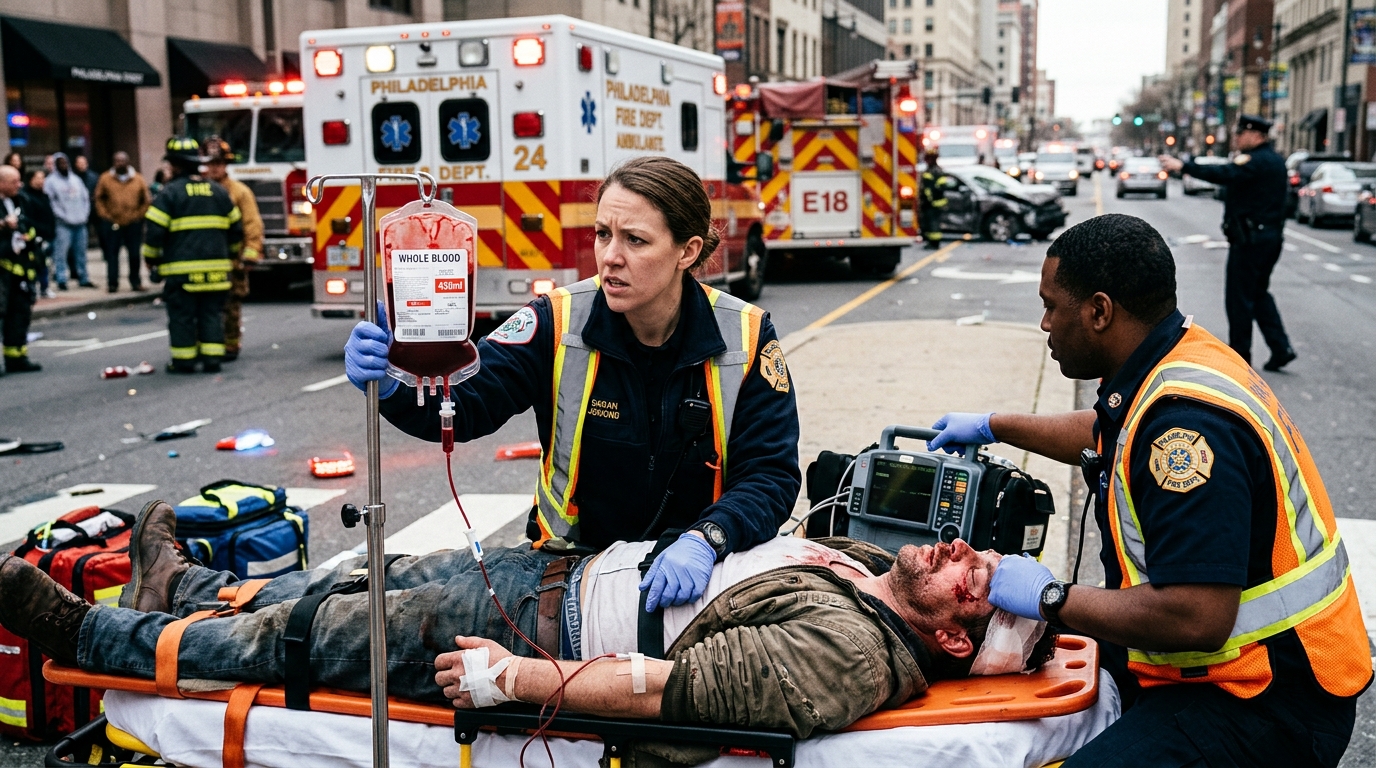
Emergency medical services across the United States are increasingly carrying blood to trauma scenes and administering transfusions before patients reach hospitals.
Emergency medical services across the United States are increasingly carrying blood to trauma scenes and administering transfusions before patients reach hospitals. The National Highway Traffic Safety Administration awarded $50 million on April 10, 2026, to expand prehospital blood programs, which currently operate in roughly 300 of the nation's 15,000 EMS agencies—up from a few dozen two years ago.
Paramedics with AMR Hartford and other ambulance services now carry type O blood, which is compatible with all blood types, and use portable warming equipment to administer transfusions in the field. Paramedic Tia Olson, a field supervisor with AMR Hartford, described the immediate effects: patients regain consciousness within one to two minutes, vital signs stabilize, and color returns to their skin. Dr. John Pettini, the EMS medical director for St. Francis Hospital in Hartford, stated that prehospital blood transfusion represents a major advancement in trauma care, citing research from the American College of Emergency Physicians showing a 37% reduction in mortality when blood is administered before hospital arrival. The practice originated in military medicine, where medics found it dramatically improved survival rates for combat casualties. NHTSA Administrator Jonathan Morrison said his agency is prioritizing rapid expansion, with funding distributed to programs from rural Oregon to Tampa, Florida.
Context
The military pioneered prehospital blood transfusion after observing that early transfusions improved survival among wounded soldiers. Medics informally called the practice "Jesus juice" because of its dramatic restorative effects. Dr. Pettini emphasized that every minute without transfusion in severe hemorrhagic shock increases mortality, making speed critical even in urban settings where hospitals are relatively close. The practice requires careful logistics: blood must be stored at precise temperatures and warmed before administration, and supplies must be continuously replenished since blood has an expiration date.
What's Next
The expansion of prehospital blood programs will likely accelerate given federal funding and demonstrated mortality benefits, though significant infrastructure challenges remain. Currently only 2% of EMS agencies in the U.S. operate prehospital blood programs, indicating substantial room for growth. NHTSA leadership has signaled intent to make the programs available to any interested EMT agency, suggesting the 300 current programs could expand substantially in the coming years as agencies secure funding and establish cold-chain logistics networks.
Never Miss a Signal
Get the latest breaking news and daily briefings from Zero Signal News directly to your inbox.